Houdini: Art and Magic
Escape artist and showman extraordinaire, Harry Houdini captivated the world with his astonishing feats. Stunning period posters, unusual theater ephemera, and dramatic historic photographs of Houdini’s performances are complemented by contemporary art works by artists inspired by Houdini such as Matthew Barney.
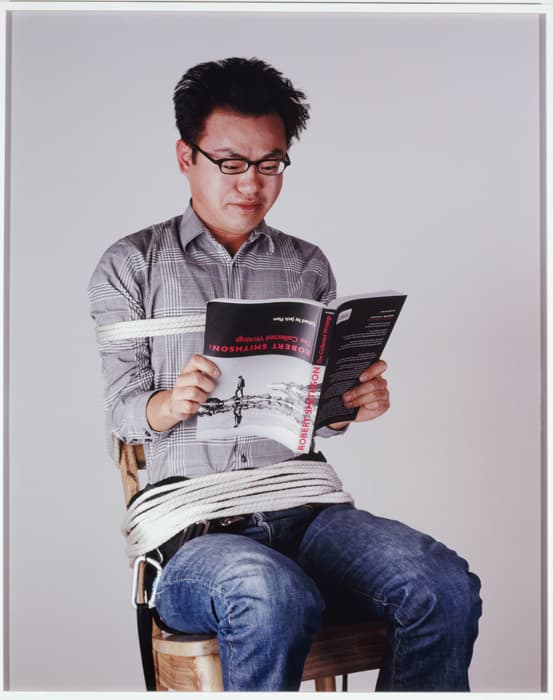
Through impossibly daring feats Harry Houdini (1874–1926) captivated audiences worldwide, and his legendary escapes instill awe to this day. Houdini: Art and Magic, the first art exhibition in an American art museum on the master magician, features magic apparatus such as his straitjacket, handcuffs and milk can, posters, broadsides, period photographs, archival films, and contemporary art work by artists such as Matthew Barney, Petah Coyne, Jane Hammond, Vik Muniz, Deborah Oropallo and Raymond Pettibon.
The exhibition explores how Houdini’s role as an American icon was transformed across three centuries, first in the late nineteenth century by Houdini’s own interpretation of his status, next by twentieth-century popular culture, and today by contemporary artists who conjure Houdini as an audacious performer and showman of raw physicality. The theme of escape animates Houdini’s work and permeates the film footage, posters, and photographs from Houdini’s day. While Houdini deliberately controlled his image, after his death in 1926 and his wife’s death in 1943, contemporary culture held sway. The magician was no longer an audacious apostle of grueling physical activity but a leading man with silver-screen appeal. By the 1970s, his edgy performances that caused fear, excitement, and apprehension in his audiences at the turn of the last century were a source of inspiration for contemporary vanguard artists.
Houdini not only escaped from physical constraints and potentially deadly situations but was himself an exemplar of the American dream, escaping the past and succeeding in the new world. Born Ehrich Weiss, Houdini made an immigrant’s getaway from Budapest to Appleton, Wisconsin to New York. Finding the bright lure of the big stage greater than the austere pulpit of his father’s rabbinic profession he joined the circus, ultimately arriving on the national and international stage. Houdini’s career and performances embodied key elements of the American archetype: hard work, ingenuity, modernity, and renewal. His significance as a Jew who became a popular phenomenon attracting huge crowds and a muse for contemporary artists and writers is extraordinary.
Houdini: Art and Magic was generously funded by Jane and James Stern, Kathryn and Alan C. Greenberg, and the Blanche and Irving Laurie Foundation, with additional support from Rita and Burton Goldberg, the National Endowment for the Arts, The Philip and Muriel Berman Foundation, the Susan and Elihu Rose Foundation, and other donors.
Corporate support was provided by .
The Skirball Fund for American Jewish Life Exhibitions, the Dorot Foundation publications endowment, the Neubauer Family Foundation Exhibition Fund, and the Horace W. Goldsmith Foundation Exhibition Fund also provided important funding.
Media Sponsor:
Special thanks to the following magicians for graciously donating their performances: David Blaine, Adam Blumenthal, Steve Cohen, Lyn Dillies, Will Fern, Eric Goldfarb, Matt Holtzclaw, Joshua Jay, Rich Kameda, Michael Kirschner, Doug McKenzie, Jared Molten, Ben Nemzer, Ryan Oakes, Michael Patrick, and Prakash Puru.
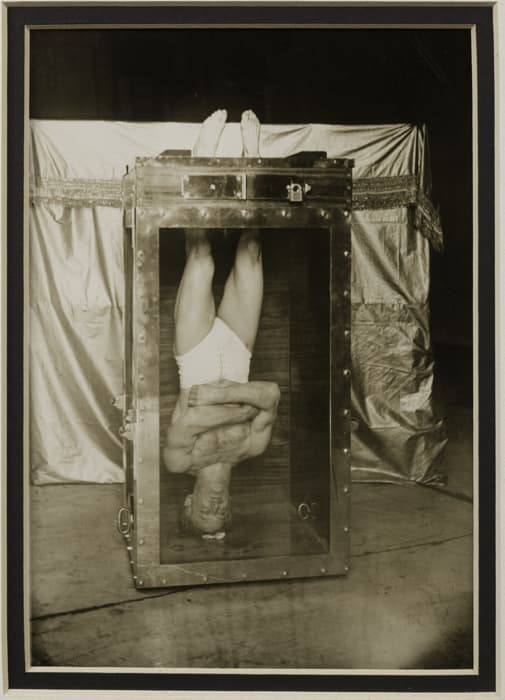
Houdini Upside Down in the Water Torture Chamber, c. 1912, photograph, 6 x 4 1/4 in. (15.2 x 10.8 cm). Kevin A. Connolly Collection
Exhibition highlights
-

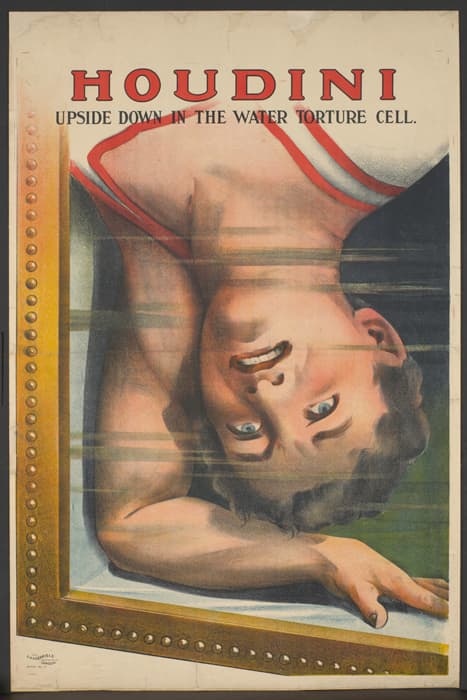
Houdini Upside Down in the Water Torture Cell, c. 1913, lithograph, approx. 24 x 16 in. (61 x 40.6 cm). The New York Public Library for the Performing Arts, Billy Rose Theatre Collection
-
Tim Lee (Canadian, b. Korea, 1975), Upside-Down Water Torture Chamber, Harry Houdini, 1913, 2004, photograph, 45 1/4 x 49 1/4 in. (115 x 125 cm). Lent by the American Fund for the Tate Gallery, Courtesy of the American Acquisitions Committee, 2006